
Mastering SaaS Pricing Strategies- A Comprehensive Guide
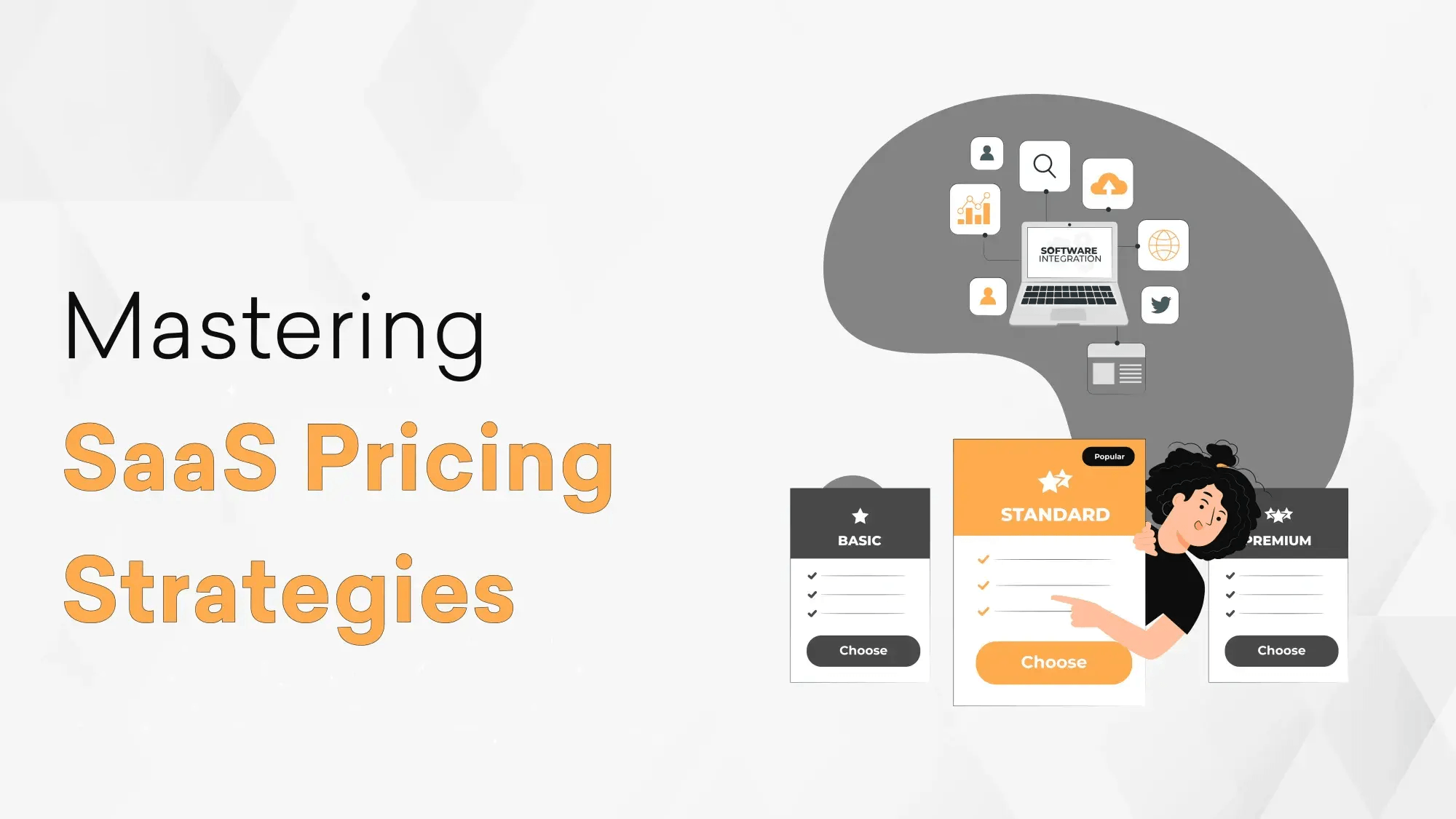
Pricing is one of the most powerful levers in any SaaS business.
SaaS pricing strategy determines not just how you generate revenue, but how customers perceive value, adopt your product, and stay long term. I understand how overwhelming pricing decisions can feel, especially when growth, churn, and investor expectations all tie back to that single number.
Effective SaaS pricing requires disciplined alignment between your value proposition, ideal customer profile, competitive positioning, and revenue goals. When structured correctly, pricing becomes a growth accelerator, influencing acquisition, retention, and expansion simultaneously.
This guide breaks down the core components of mastering SaaS pricing in a way that supports sustainable growth rather than short-term revenue spikes.
Understanding the SaaS Business Model
A strong SaaS pricing strategy begins with understanding the mechanics of recurring revenue.
Unlike traditional software models, SaaS depends on subscription-based income. That means pricing must reflect continuous value delivery rather than one-time transactions.
Recurring revenue shifts focus from initial sale size to lifetime value, retention, and expansion. Pricing decisions must therefore balance cost structure, competitive positioning, and perceived customer value.
Mispricing at this stage compounds over time. Two key factors impact pricing:
The Role of Cost, Value, and Competition
Unlike traditional software, SaaS relies on recurring subscription revenue rather than high upfront licensing fees. Pricing must therefore reflect sustained value delivery.
Infrastructure cost and competitive benchmarks matter, but customer-perceived value is the decisive factor. Price too low and you under-monetize impact. Price too high and acquisition slows.
The objective is precision, aligning pricing with measurable value delivered to the target customer.
Identifying Your Target Audience
Before structuring SaaS pricing, clearly define your ideal customer.
In B2B SaaS, it is not just the company that matters, but the persona driving adoption. The economic buyer may approve payment, but the internal champion influences usage and expansion.
Pricing must resonate with both ROI expectations and operational value. Know the persona that creates momentum inside the organization. For a B2B SaaS product, who is the user or champion that will adopt and sell it internally?
Let's say you're focusing on B2B. It's not just about the businesses but about the individuals within those companies. If you're selling an SEO tool, for instance, the end-user might be the SEO specialist in a company. They are the ones you need to appeal to. Just advertising to the CEO might not yield results because, while they might be the ones paying, they aren't the primary users.
The SEO specialist, on the other hand, can convince the decision-makers of its worth. So know your customer, not just the company.
Core SaaS Pricing Models
SaaS businesses have several options when structuring their pricing model. The model you choose impacts everything from cash flow to customer lifetime value.
However, research shows that the average SaaS startup spends just six hours developing its initial pricing strategy. This lack of attention to pricing can be a costly mistake.
Below are some of the most common SaaS pricing approaches, with the pros and cons of each.
Subscription-Based Pricing
Subscription pricing remains the most common SaaS model.
Customers pay a recurring monthly or yearly fee, creating predictable revenue. The strength of this model lies in retention, revenue compounds as customer lifetime increases.
However, churn risk rises if value delivery weakens. Subscription pricing rewards consistent product performance.
Subscription pricing rewards customer loyalty and retention, as companies must maintain their subscription to continue accessing the software.
Pros:
- Predictable recurring revenue
- Lower entry prices can attract customers
- Rewards customer loyalty
Cons:
- Risk of churn if the value is not continually delivered
- Slow ramp of revenue per customer
Partner with Us for Success
Experience seamless collaboration and exceptional results.
Usage-Based Pricing
Usage-based pricing aligns cost directly with customer consumption.
Customers pay based on measurable metrics such as API calls, storage, or compute usage. This model feels equitable because payment scales with extracted value.
The trade-off is revenue unpredictability and increased tracking complexity.
Pros:
- Aligns cost with resources consumed by the customer
- Customers only pay for what they use
Cons:
- Unpredictable revenue
- Complex pricing tiers
- Resource-heavy usage tracking
Tiered Pricing
Tiered pricing segments customers across differentiated packages.
Higher tiers unlock expanded features, usage limits, or seats. This structure captures additional revenue from power users while providing a natural upsell pathway.
Clarity is essential, each tier must communicate distinct value.
This lets SaaS companies capture more revenue from high-usage power customers. It also provides an upsell path to expand contract values as customers grow. Overall, tiers must communicate the differentiated value you deliver to justify incrementally higher prices.
Pros:
- Captures value from higher-usage customers
- Upsell path for expanding accounts
Cons:
- Can be confusing for customers to understand
- May incentivize downgrade churn
Freemium
Freemium removes barriers to adoption by offering a limited free version alongside paid tiers.
This model accelerates acquisition but requires large user volumes, as only a small percentage convert to paid plans.
Freemium succeeds when upgrade triggers are strategically designed. Thus freemium requires drastically larger user volumes to monetize versus pure paid products.
Pros:
- Drives adoption and viral growth
- Low-risk trial experience
Cons:
- A small percentage convert from free to paid
- Free users cost money to support
One-Time Licensing
One-time licensing generates immediate revenue through upfront payment.
While renewal risk disappears, long-term revenue growth slows due to limited expansion opportunities.
For scalable SaaS businesses, recurring revenue models typically provide stronger lifetime value.
Pros:
- Larger one-time revenue per customer
- No ongoing renewal risk
Cons:
- Very slow to grow revenues over time
- Lose out on account expansion revenue
Key Considerations in SaaS Pricing
Beyond the pricing model, there are several important factors to consider when developing your SaaS pricing strategy.
Balancing Acquisition and Retention
SaaS pricing must balance new customer acquisition with lifetime value optimization. If pricing prioritizes affordability alone, revenue expansion suffers. If pricing prioritizes extraction, acquisition slows. Sustainable growth requires calibrated pricing that supports both entry and expansion.
For many SaaS firms that align product development with revenue targets, existing accounts generate over 100% more revenue through renewals, upsells, and expansions compared to new customer acquisition. So for a healthy SaaS business, you must find the right balance between new customer affordability and maximizing lifetime value of retained accounts.
When to Adjust Prices
Pricing should evolve as your SaaS product matures.
Infrastructure costs, market positioning, and feature depth change over time. Incremental adjustments maintain trust while capturing increased value.
Avoid stagnation. Avoid shocks. Adjust with discipline.
Partner with Us for Success
Experience seamless collaboration and exceptional results.
Review usage data and customer feedback regularly. Make incremental pricing adjustments to find the optimal price point at each stage of growth.
For example, you may increase prices gradually by a few percentage points each year. Avoid drastic price hikes that shock customers. But don't leave money on the table by neglecting to increase prices for years either. Evolve pricing in line with your SaaS product's maturity and growing capabilities.
Localization and Currency Considerations
For SaaS firms selling into international markets, pricing must adapt to different geographic regions and foreign currency fluctuations. Your US dollar-priced tiers that seem reasonable domestically may not translate cleanly into other markets.
Dig into exchange rates, local wages, and purchase power parity to appropriately localize pricing in each target country. Regularly review international pricing levels against currency shifts as well.
Factor taxes, fees, and payment friction into international pricing strategies too. SaaS makes selling globally easier than ever. However, localization, currency adjustments, and taxes add complexity when pricing overseas.
Discounts, Trials and Promotions
Discounts and trials can accelerate acquisition, but overuse conditions customers to expect reduced pricing. Use incentives tactically at high-impact stages in the customer journey. Align promotions with long-term retention goals rather than short-term conversions. Strategic deployment protects perceived value.
Avoid making trials so extensive that users extract significant value without ever converting. For promotions, consider offering added services or premium support as bonuses rather than direct discounts.
For example, offer three months free for any friend referred who also signs up. Overall, use trials, discounts, and promotions tactically versus as a default strategy. They can boost conversions when used judiciously at key stages of the customer journey, just make sure they align with broader SaaS best practices & pitfalls to avoid costly mistakes.
Tools and Techniques for SaaS Pricing Analysis
Setting an optimal SaaS pricing strategy is challenging. However, there are methods to gain pricing insights versus relying on guesswork. Here are some key tools and techniques for analyzing and validating pricing:
Customer Willingness-to-Pay Surveys
Validate pricing through direct customer input. Understanding willingness-to-pay reduces assumption-driven decisions and strengthens confidence in price positioning.
Tools like Price Intelligently or Open AI offer willingness-to-pay survey templates. Ask about specific features, use cases, number of users, etc.
This reveals true pricing tolerance and where your planned pricing aligns or diverges from customer expectations.
Competitive Benchmarking
Competitor pricing provides positioning context. Use benchmarking as guidance, not imitation. Price according to differentiated value.
This benchmarks your pricing against substitutes customers see as alternatives. You can match, undercut, or position above based on your product differentiation. But ignoring competitors leaves you pricing in a vacuum.
A/B Testing for Pricing
Treat pricing as an iterative optimization process. Controlled testing minimizes risk and reveals elasticity patterns across customer segments. Measure conversion impact across visitor segments. This incremental approach prevents drastic moves that could sink conversion.
For example, if you know your product can save a customer $5,000 monthly, don't be afraid to price higher than $50. But test it. Choose customer segments where the ROI is clearest. Then set pricing aligned to the sizable value created.
Evaluating ROI delivered for customers provides clarity on pricing potential. But test pricing thoroughly. Not every customer will be the ideal fit despite ROI. Carefully identify high-value customer segments. Then develop pricing suited to each vertical, size, and use case.
Common SaaS Pricing Pitfalls (and How to Avoid Them)

SaaS pricing missteps can sabotage growth. Here are pitfalls to avoid:
- Not confirming pricing through customer validation - Ask directly what they would pay. Don't assume.
- Copying competitors' pricing without differentiation - Your product and positioning are unique. Price accordingly.
- Complex pricing plans - Too many tiers or metrics confuse customers. Simplify.
- Fear of pricing too high - Test higher prices on ideal customers. You may be leaving money on the table.
- No recurring price reviews - Pricing must evolve with your product's growth and changing market. Review frequently.
Final Thoughts
SaaS pricing strategy requires continuous reevaluation as your business grows. Pricing is not a set-it-and-forget-it decision. Your pricing must adapt in response to customer feedback, usage data, market trends, and the evolving maturity of your SaaS product.
SaaS Pricing is complex and ever-evolving. If you need personalized advice on refining your SaaS pricing strategy, F22 Labs - a renowned SaaS development company is here to help. Please reach out to us for a 1-Hour free consultation on optimizing your SaaS pricing for growth.

Murtuza Kutub
A product development and growth expert, helping founders and startups build and grow their products at lightning speed with a track record of success. Apart from work, I love to Network & Travel.


