15 Tips To Hire Developers For Your Startup in 2026
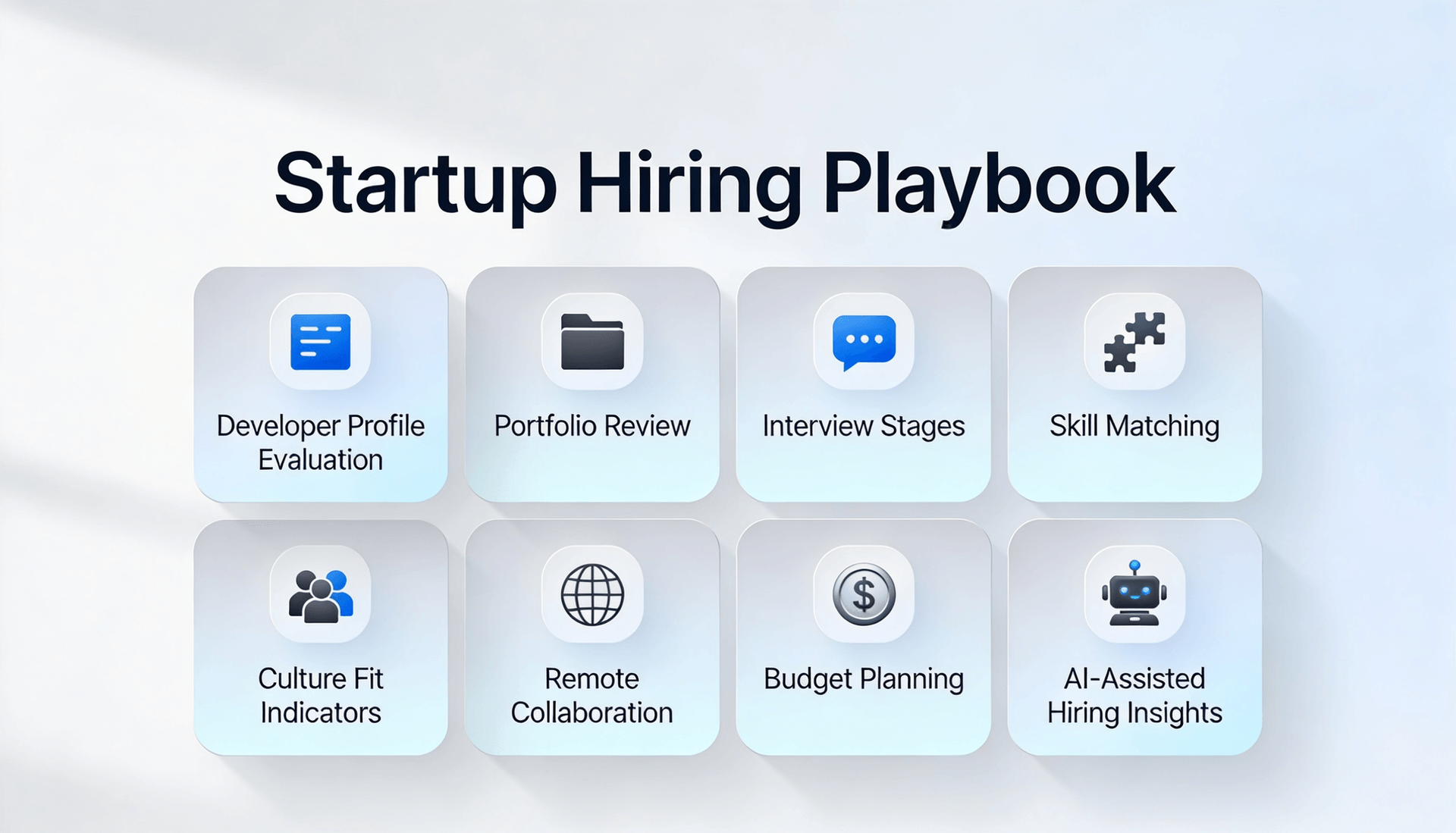
Finding developers is hard. Finding the right developers for a startup is harder. You're competing with companies that can offer higher salaries, better-known brands, and more job security, and you're doing it with a smaller hiring team, a tighter budget, and less time to get it wrong.
The good news is that startups have real advantages when they know how to use them. This guide covers 15 practical tips for hiring developers in 2026, what it actually costs, and the mistakes worth avoiding before you make your first hire.
Why Startup Developer Hiring Is a Different Problem?
At a large company, a bad developer hire is an inconvenience. At a startup, it can set the product back by months. Early developers don't just write code; they shape your architecture, establish your engineering culture, and determine how easily the next five hires can do their jobs.
The stakes are higher, the margin for error is smaller, and the hiring process most companies use rarely surfaces the kind of developer a startup actually needs. This is why following structured tips to hire developers becomes important for startups.
Get These Three Things Right Before You Start Hiring
1. Define what you need to build, not just who you want to hire.
A job description built around titles and years of experience will attract the wrong candidates. Before writing a single job post, define the technical problem you need solved: Are you building an MVP? Scaling an existing product? Integrating external systems? Your answer determines the role, the seniority level, and whether you need a generalist or a specialist.
2. Choose your tech stack before hiring developers.
The technologies you build on determine which developers you need, how your product scales, and what your long-term hiring costs look like. Choosing a stack because a candidate knows it is backwards. Choose a stack based on your product requirements, then hire people who know it, or who can learn it fast.
3. Decide your hiring model early.
The model you choose affects cost, speed, accountability, and how much management effort falls on you. The four main options for startups:
| Model | Cost | Best For | Risk |
Freelancer | $30–$100/hr | Short-term, well-scoped tasks | High — variable accountability |
Dedicated Developer | $5,000–$12,000/month | Ongoing product development | Low — focused on your product |
Development Agency | Project-based | End-to-end builds | Medium — depends on agency |
In-House Developer | $90,000–$160,000/yr | Long-term, core team roles | Low — highest alignment |
For most early-stage startups, a dedicated developer through a managed partner is often the most cost-effective model, particularly for founders comparing hiring approaches with MVP development services.
15 Tips to Hire Developers for Your Startup
1. Hire for the Outcome, Not the Job Description
Write the role around what needs to get done in the first 90 days, not a generic list of technologies. "Build and ship the MVP for our core user flow in 10 weeks" attracts a different, and usually better, candidate than "5+ years of experience in React."
2. Look Beyond Degrees and Resumes
A growing number of the best developers are self-taught or bootcamp-trained. Stack Overflow's developer survey consistently shows that a large proportion of working developers didn't follow a traditional CS degree path. Filtering by educational credentials cuts your talent pool significantly, often eliminating your best candidates.
3. Find Developers Where They Actually Spend Time
Most strong developers aren't browsing job boards. Look for them on GitHub (search repositories in your tech stack), Stack Overflow (check contributor profiles), developer communities on Discord and Slack, and local hackathons and meetups. A developer active in open source or community contributions has already demonstrated initiative, which is exactly what a startup needs.
4. Use Equity as a Hiring Weapon
This is the most underused advantage startups have. A senior developer at a big tech company might earn $200,000 a year but own no meaningful stake in what they're building. A meaningful equity offer, structured properly, with a clear vesting schedule, can attract developers who want ownership, not just a paycheck. Be transparent about the cap table, the funding stage, and what the equity could realistically be worth.
5. Sell the Mission Before You Discuss the Salary
Developers at the quality level startups need have options. What they're often choosing between isn't just compensation, it's the type of work they want to do and whether it matters.
Partner with Us for Success
Experience seamless collaboration and exceptional results.
Be direct about the problem you're solving, why it's worth solving, and what the developer's role in solving it will be. Purpose-driven candidates make better startup hires than purely compensation-driven ones.
6. Get a Technical Person Into the Hiring Process
If you're a non-technical founder, you need a technical co-founder, advisor, or trusted senior developer involved in evaluating candidates. A skilled developer can identify weak technical answers, assess code quality, and ask the questions that reveal how someone actually thinks about engineering problems.
Hiring senior developers without technical validation is one of the most common and costly startup hiring mistakes.
7. Test With Real Work, Not Hypotheticals
Whiteboard questions and algorithmic puzzles don't tell you how someone builds software in a real, fast-moving environment. Give serious candidates a small, paid task that mirrors actual work on your product, a bug fix, a feature spike, or a small component from scratch.
Pay them for it. The output tells you more than any interview round, and the fact that you paid signals that you're serious.
8. Assess Startup Fit, Not Just Technical Skill
A developer who thrives at a large company with defined processes and large teams may struggle in a startup where priorities shift weekly, documentation is sparse, and they're expected to make independent decisions.
Ask candidates directly: What does your best working environment look like? How do you handle changing requirements? What have you built from scratch versus inherited? Their answers reveal whether they're wired for startup conditions.
9. Prioritize Learning Speed Over Current Knowledge
Technologies evolve. The stack you're building on today may shift in 18 months. A developer who picks up new languages quickly and approaches problems with intellectual curiosity is a better long-term bet than one with deep knowledge of your current stack but a rigid approach to learning. Ask candidates to describe a technology they taught themselves recently and why.
10. Go Remote-First to Access Affordable Senior Talent
Restricting your search to local developers in major US cities significantly limits your pool and inflates your costs. Senior developers in Latin America, Eastern Europe, and parts of Asia offer comparable technical quality at 40–60% lower cost.
In 2026, remote-first engineering teams are the norm, not the exception; the tooling for async collaboration is mature, and the talent available globally is deep.
11. Vet Communication Skills as Rigorously as Technical Skills
At a startup, developers don't just write code; they interact with founders, contribute to product decisions, and often communicate directly with stakeholders.
A developer who can't explain a technical trade-off clearly or pushes back on ambiguous requirements without communicating why will slow everything down. Communication quality is a hiring filter, not a soft bonus.
12. Check References Specifically, Not Generally
"Was this person good to work with?" produces useless answers. Ask references: What's the most complex problem you saw them solve? How did they handle a project that went off track?
Would you hire them specifically for a fast-moving startup environment? Specific questions surface specific, useful information. Generic questions produce glowing generalities.
13. Move Fast, Strong Developers Don't Wait
The best candidates are often in multiple interview processes simultaneously. If your hiring process takes four weeks from application to offer, you'll lose candidates to companies that move in ten days.
Pre-define your evaluation stages, get decisions made quickly, and extend offers promptly. Speed in hiring is a competitive advantage startups can use against larger, slower organizations.
14. Start With a Trial or Contract-to-Hire
Before committing to a full-time hire or a long-term engagement, run a paid trial, a two-to-four week project that mirrors real work. You'll evaluate technical output, communication, reliability, and cultural fit before making a long-term commitment.
This reduces risk significantly, especially for your first one or two engineering hires, where a wrong decision is hardest to reverse.
15. Build a Talent Pipeline Before You Need It
The worst time to hire is when you desperately need someone. Keep warm relationships with developers you've met at events, contributors who've engaged with your open source work, and candidates who were strong but not quite right for the role you were hiring at the time.
A maintained pipeline means that when you need to hire fast, you're not starting from zero.
Common Mistakes to Avoid While Hiring Developers
1. Optimizing for cost above everything else.
The cheapest developer available rarely turns out to be the most affordable one. Poor code, missed deadlines, and architectural decisions that have to be undone cost multiples of the money saved upfront.
Partner with Us for Success
Experience seamless collaboration and exceptional results.
2. Hiring generalists when you need specialists, or vice versa.
Early-stage products often need full-stack generalists who can move fast. Scaling products needs specialists who go deep. Mismatching the type of developer to the stage of the product is one of the most common and most avoidable startup hiring errors.
3. Skipping the reference check.
Especially for senior hires, reference checks are not a formality; they're due diligence. One direct conversation with a former manager reveals things no interview process will surface.
4. Ignoring cultural fit under time pressure.
When you're under pressure to ship, it's tempting to hire fast and figure out the cultural fit later. Developers who don't align with how your team works create friction that slows everything down and often leads to a difficult exit anyway.
How Much Does It Cost to Hire Developers for a Startup?
| Role / Model | Estimated Cost |
Junior Developer (in-house, USA) | $70,000 – $100,000/yr |
Mid-Level Developer (in-house, USA) | $100,000 – $140,000/yr |
Senior Developer (in-house, USA) | $140,000 – $180,000/yr |
Freelance Developer | $50 – $150/hr |
Dedicated Developer (managed partner) | $5,000 – $12,000/month |
Nearshore Developer (Latin America) | $40 – $80/hr |
Offshore Developer (India / E. Europe) | $25 – $60/hr |
For seed and pre-Series A startups, a dedicated developer model through a managed partner typically delivers the best cost-to-output ratio, senior expertise, no full-time employment overhead, and a process you don't have to build yourself.
Why F22 Labs for Startup Development?
F22 Labs works with early-stage and growth-stage startups to build and scale products with pre-vetted, senior developers. No recruitment overhead, no long onboarding ramp, and no agency markup, just a dedicated developer who understands how startups move.
Whether you need to ship an MVP in eight weeks or scale an engineering team for a Series A roadmap, we offer a free 1-hour strategy consultation to help you figure out exactly what you need and what it will cost.
Frequently Asked Questions
How do I hire developers for my startup on a limited budget?
Prioritize the dedicated developer model over full-time hires to avoid employment overhead. Use nearshore or offshore talent through a managed partner for senior-quality output at 40–60% lower cost. Complement salary with meaningful equity.
What type of developer should a startup hire first?
Most early-stage startups benefit most from a senior full-stack developer who can build across the entire product. Specialists become valuable once the architecture is established and depth in specific areas is needed.
How long does it take to hire a developer for a startup?
Freelancers can be onboarded in days. Dedicated developers through a managed partner typically take one to two weeks. In-house hires average six to eight weeks from job post to start date, faster if you have a warm pipeline.
Should startups hire remote developers?
Yes, for most startups. Remote-first hiring opens access to a significantly larger and more affordable talent pool. With mature async collaboration tools available in 2026, geography is rarely a practical limitation for product development.
What's the biggest hiring mistake startups make?
Hiring based on cost alone. Cheap development that produces poor architecture or inconsistent quality costs more to fix than it saved to build. Evaluate total value, quality, reliability, and long-term maintainability, not just the hourly rate.

Murtuza Kutub
A product development and growth expert, helping founders and startups build and grow their products at lightning speed with a track record of success. Apart from work, I love to Network & Travel.